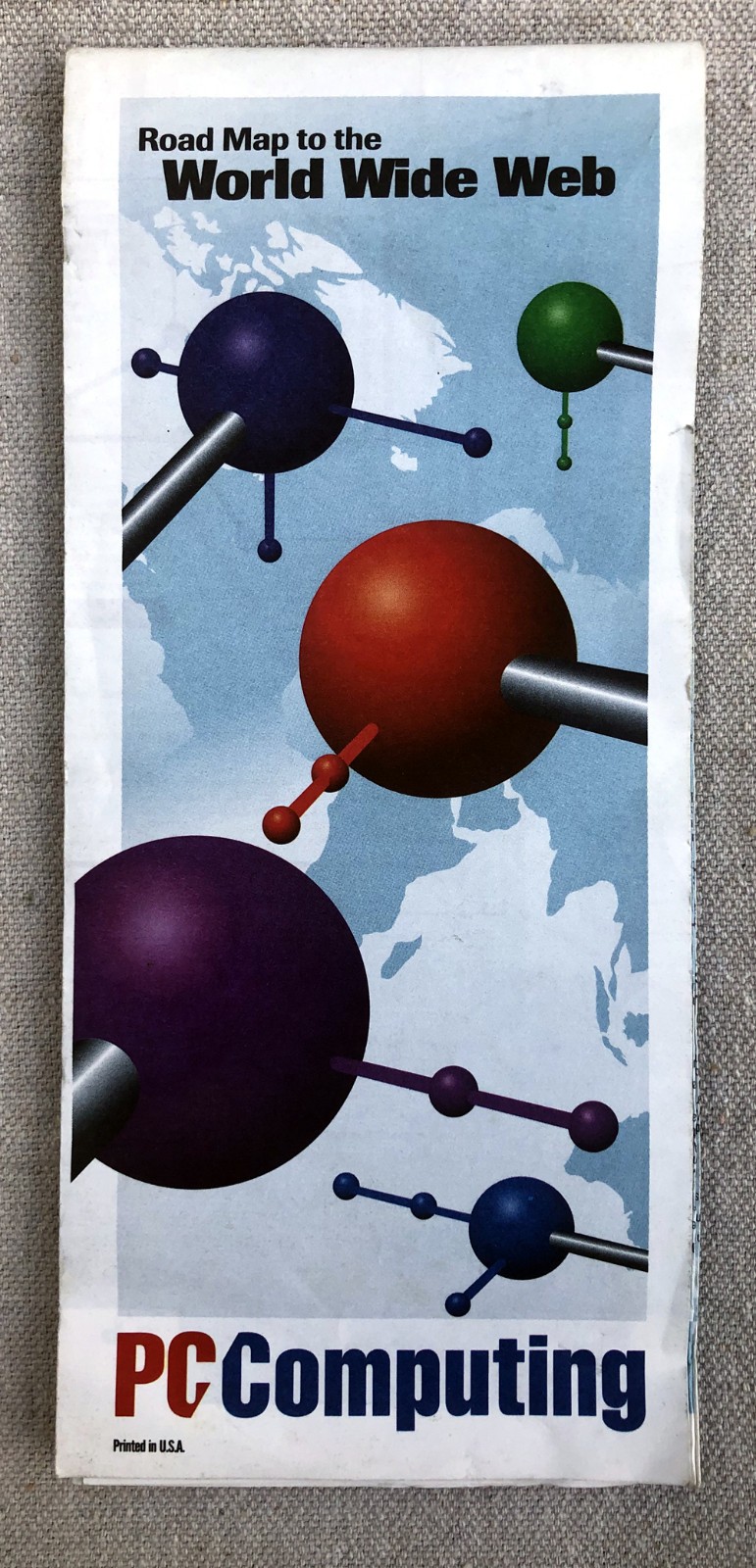
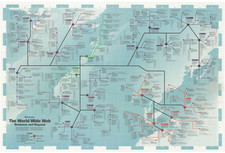
PC Computing Road Map to the World Wide Web 1995 Timothy Edward Downs Rare RetroTimothy Edward Downs’s 1995 'Road Map to the World Wide Web' translates the nascent internet into a legible, cartographic form. At first glance, the recto resembles a classic metropolitan diagram: large, colored hubs tied together by radiating lines, nodes marked like stations, and a careful hierarchy of type that tells the eye where to look. The metaphor is literal as well as visual: Downs borrows the vocabulary of subway and road maps—rings, spokes, transfer points—and deploys it as a cognitive framework for an otherwise invisible and abstract information network. The effect is not merely decorative. By grafting the Web’s emergent logic onto familiar cartography, the map gives newcomers a practical way to navigate an unstructured terrain.
The recto is organized around a small set of major subject hubs. Each hub functions as a thematic center (e.g. Business & Finance, Education, Travel & Leisure, Government & Law, Personal Interest & Career, and a catch-all category labeled Meta-Pages). Sub-lines and offshoots radiate from these hubs, identifying subtopics and individual websites under each category. Each listed site is accompanied by a short information capsule with a one-line description, a URL, and occasionally a wry editorial comment. The capsule entries are informal enough to convey personality and opinion, but also functional in their listing of concrete URLs. The map thus balances utility and temperament and is simultaneously both a directory and a cultural snapshot.
Visually and conceptually, Downs’s map differs from his earlier 1994 Road Map of the Internet, which mapped servers and technical connections. The 1995 WWW map shifts focus from machines to content, emphasizing social aspects of the web and the websites that exemplify this trend. This is an important distinction, as it reflected the then-ongoing transition from the Internet as an infrastructure to the World Wide Web as a layer of networked information and public pages that straddle the older infrastructure. Downs’s schematization makes that shift intelligible and intuitive by allowing viewers to navigate by subject and destination rather than by a machine name.
A close look at the recto reveals the mapmaker’s considered typographic and pictorial choices. Lines are clean and deliberately non-literal; nodes are sized and grouped to imply prominence without pretending to statistical rigor. Occasional visual cues, such as small arrows, boxed annotations, and short “how to use this map” tips printed in the margins, make this an explicitly functional composition.Verso: The “user manual” for a new medium
The verso makes explicit what the recto implies. The back is organized as an operational companion to the map, including an alphabetical index of listed sites, short highlight essays that recommend notable destinations, a concise primer on “how to connect” (modem basics, dial-up etiquette, choosing an ISP), and a brief guide to reading the map itself. The comprehensive and pedagogical information on the verso presumes a curious but inexperienced audience of potential users in need of concrete steps. By reducing the initial learning-curve friction that, in the mid-1990s, still kept many people away from the technology, Downs’s map above all serves to demystify.
Several elements on the verso are worth highlighting. The index enables name-based searches, converting the visual, associative recto into an addressable directory. The “how to” instructions are compact and pragmatic, including notes on modem speeds, connection sequences, and a few troubleshooting pointers. The verso is also editorial, in that Downs and the PC Computing team refer to some of the sites that they believed to be most useful, entertaining, or surprising. In doing so, the compilers performed some of the vetting or curatorial functions that search engines could not yet fully provide. In combination, recto and verso form a complete beginner’s kit: orientation through metaphor on the front; operation and follow-through on the back.Census
The present 'Map to the World Wide Web' was published in 1995 as a promotional appendage to the magazine PC Computing. It constitutes one in a series produced by the iconic tech-illustrator Timothy Edward Downs. Each map was folded like an AAA road map and shrink-wrapped with issues.
Condition:
Preowned Good Condition. Please note! There are a few rough edges on the cover fold. Slight discoloring along the folded creases, normal folding wear. Please view the supplied photos.Measurements:91.5 x 58.5 cm (36 x 23 in)
Please view our policies, and shipping information. Check the supplied photos and the actual item or garment measurements if they apply. Please feel free to ask questions, and or address concerns before purchasing.