3m MTP to LC Breakout Fiber Cable, OM4 50/125 Corning 8 Fiber Multimode, Plenum OFNP, Aqua
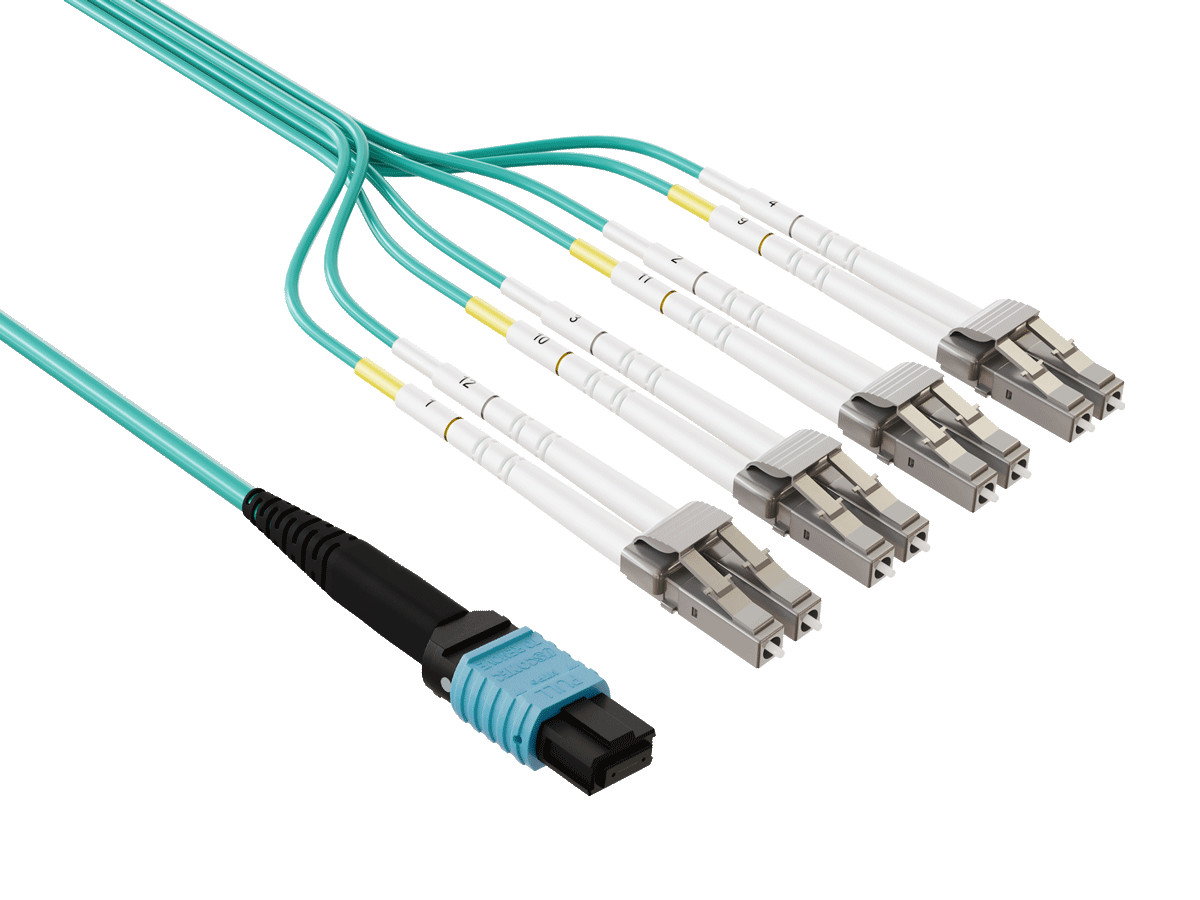
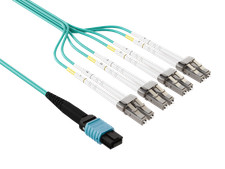
The CableLeader FB124-4CXX is an OM4 multimode breakout fiber cable that converts one MTP/UPC connector into eight LC/UPC connectors arranged as four duplex pairs. Eight Corning 50/125 um OM4 fibers travel inside a 3.0 mm aqua single-tube trunk jacket, then fan out through a molded transition into 2.0 mm legs, each 800 mm long and identified by color-coded markers. The assembly gives parallel-optics hardware a direct path into duplex LC equipment without an intermediate cassette.
The MTP end is a US Conec MTP Elite female connector built on a 12-position MT ferrule with eight fiber positions populated. Female (unpinned) is the correct gender for plugging straight into parallel-optics transceivers, whose MPO receptacles carry the alignment pins. The push-pull tab releases the connector in one motion, useful when QSFP ports sit stacked in dense switch faceplates. Insertion loss at this end is factory-limited to 0.35 dB maximum with return loss of 20 dB minimum.
The LC end presents four duplex LC/UPC pairs with staggered terminations, so each pair reaches its port without bunching at the panel. Each LC connector is tested to 0.20 dB maximum insertion loss and 30 dB minimum return loss, measured at both 850 nm and 1300 nm operating windows. Those figures keep the whole breakout within the loss budget expected of OM4 links between parallel and duplex optics.
The jacket carries an OFNP plenum listing under UL file E510298 along with RoHS compliance. OFNP is the highest fire rating for optical cable, permitted in air-handling plenum spaces such as drop ceilings and raised floors, and it substitutes freely where only riser-rated cable is required. The aqua color follows the industry convention for OM4 multimode cabling, keeping fiber types visually distinct inside trays and panels.
Typical deployments center on port breakout in data centers and enterprise server rooms. Network teams commonly split a 40GBASE-SR4 QSFP+ uplink into four 10GBASE-SR SFP+ links, or a 100GBASE-SR4 QSFP28 port into four 25GBASE-SR SFP28 links, landing the LC pairs on top-of-rack switches, servers, or LC patch panels. The same construction serves cassette-free MTP-to-LC transitions inside fiber distribution frames.
Compatibility & Ordering Information — FB124-4CXX mates with pinned MPO/MTP ports on parallel-optics multimode transceivers, including QSFP+ 40GBASE-SR4 and QSFP28 100GBASE-SR4 modules used in Cisco, Arista, Juniper, and Mellanox platforms; the LC ends fit any standard LC/UPC port, adapter panel, or SFP+/SFP28 optic. Verify connector gender before ordering: this cable is female on the MTP side, which matches pinned transceiver ports. The family is offered in lengths from 1 m through 30 m. For the single mode version of the same breakout, see the FB126-9CXX family; MTP trunk cables are available as FB125-9BXX and FB127-9BXX.
Product Comparison: MTP Breakout Cable vs MTP Trunk Cable
Both constructions use MTP parallel-optics connectivity; the difference is what sits at the far end of the link. The table summarizes the decision:
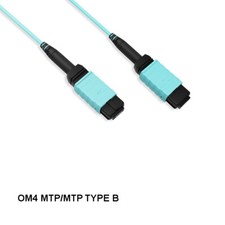
AttributeMTP to LC Breakout (this product)MTP to MTP TrunkConnectorsOne MTP/UPC female to eight LC/UPC (four duplex pairs)MTP connector on both endsLink TypeOne parallel-optics port to four independent duplex linksParallel port to parallel port, or backbone between cassettesTypical Use40G QSFP+ port broken out to four 10G SFP+ optics; MTP port to LC patch panelSwitch-to-switch 40G/100G links; structured backbone feeding MTP-LC cassettesConnection PathDirect — no cassette needed, fewer mated pairs in the loss budgetUsually paired with cassettes or adapter panels at one or both endsMoves and ChangesFixed fan-out; re-terminating the LC side means replacing the cableFlexible — LC patching happens at the cassette, trunk stays in placeThis FamilyOM4 50/125 Corning 8 fiber, plenum OFNP, aqua, 1M–30MSee OS2 single mode trunk families (Type A and Type B) in this catalog
Select the breakout cable when a parallel-optics MTP port must feed duplex LC equipment directly.
Select a trunk cable when both ends are MTP ports or the link feeds MTP-LC cassettes in structured cabling.
FAQ
What is the difference between MTP and MPO connectors?
MPO is the generic connector standard, and MTP is US Conec's engineered brand of MPO with tighter mechanical tolerances and a removable housing — the two are fully intermateable. This cable uses a genuine US Conec MTP Elite female connector, so it plugs into any standards-compliant MPO or MTP port of matching gender and fiber count.
Is this breakout cable compatible with QSFP+ 40GBASE-SR4 transceivers?
Yes. 40GBASE-SR4 transmits over four multimode fiber pairs through a pinned MPO port, and this cable's female MTP end mates with that port directly. The four LC duplex legs then connect to 10GBASE-SR SFP+ optics or LC panels, which is the common way a 40G port is broken out into four 10G links.
Why does this cable use 8 fibers instead of 12?
Parallel-optics links such as 40GBASE-SR4 and 100GBASE-SR4 use exactly eight fibers — four transmit and four receive — so an 8-fiber cable matches the transceiver with no dark fibers left over. The MT ferrule still has 12 positions; the eight fibers occupy the positions the SR4 standard assigns, which is why the cable terminates in four LC duplex pairs rather than six.
How do I connect the MTP end, and does connector gender matter?
Push the MTP connector into the port until it clicks, and pull the tab to release it — no tools are needed. Gender matters: an unpinned female connector like this one must mate with a pinned male port. Parallel-optics transceivers are pinned, so the female end plugs into them directly; if you are connecting into a cassette or adapter panel instead, confirm the opposing connector is pinned.
Which should I choose, an MTP breakout cable or an MTP trunk cable?
Choose a breakout cable when one end of the link is a parallel-optics MTP port and the other end is duplex LC equipment — the cable itself performs the transition. Choose an MTP trunk when both ends are MTP ports, such as switch-to-switch parallel links or backbone runs between MTP cassettes. If your LC connections change often, a trunk plus an MTP-LC cassette offers easier moves and changes; a breakout is the leaner, lower-loss choice for fixed links.