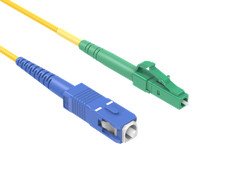
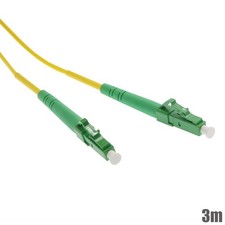
3m LC/APC to SC/APC Single Mode Fiber Patch Cable, OS2 9/125 Duplex Corning, LSZH/OFNR, Yellow
The CableLeader FB111-92XX is an OS2 single mode duplex patch cable terminated with an LC/APC connector pair on one end and an SC/APC pair on the other, both identified by green housings. APC — angled physical contact — polishes each ferrule endface at an 8-degree angle, redirecting back-reflection into the cladding rather than straight back toward the source. Both ends are rated 65 dB minimum return loss, the performance level specified for reflection-sensitive FTTH and GPON links. Inside the yellow jacket run two Corning 9/125 um G657A1 fibers.
The LC/APC end uses short boot 19.5 mm connectors that reduce rear clearance behind loaded high-density panels. LC is the small-form-factor interface of modern OLT line cards, WDM modules, and distribution frames, where its 1.25 mm ferrule doubles port density over SC hardware. Each LC/APC ferrule is factory-tested to 0.30 dB maximum insertion loss at 1310/1550 nm.
The SC/APC end carries the push-pull connector that dominates the access network: fiber wall outlets, GPON splitter ports, and ONT uplinks are overwhelmingly SC/APC. Its 2.5 mm ferrule and keyed 31.8 mm boot housing seat with a positive click, and the SC side is likewise tested to 0.30 dB maximum insertion loss. The cable therefore bridges SC/APC building plant to LC/APC electronics without splices or hybrid adapters.
The jacket is LSZH/OFNR rated under UL file E510298. Low-smoke zero-halogen material limits toxic emissions in enclosed equipment rooms, while the OFNR riser rating permits vertical runs between floors. The 2.0 mm x 4.1 mm duplex zipcord keeps each fiber in its own aramid-reinforced sub-unit, and RoHS compliance covers restricted-substance procurement requirements.
G657A1 bend insensitive glass tolerates the tight routing radii of wall enclosures, cable managers, and crowded splitter cabinets without the attenuation spikes standard G652D fiber shows under the same handling, and it remains fully compatible with installed G652D plant. Typical deployments include linking an SC/APC wall outlet to an LC/APC ONT, patching GPON splitters to OLT line cards, and extending RF-over-glass video overlays where angled polish is mandatory.
Compatibility & Ordering Information — FB111-92XX mates only with APC (green, angled) ports: LC/APC on one end, SC/APC on the other. Never plug either end into a blue UPC receptacle; the mismatch damages the angled ferrules and produces high loss. The family is offered from 1 m through 3 m; select the variant covering the outlet-to-equipment distance plus a service loop. For LC/APC on both ends see the FB110-91XX family; for SC/APC on both ends see the FB114-96XX family; for UPC-polish LC-SC data links, see the CableLeader fiber optic cables catalog.
Product Comparison: LC/APC to SC/APC vs LC to SC UPC Single Mode Patch Cable
Both cables use the same LC and SC connector formats over Corning OS2 9/125 G657A1 fiber; the difference is the endface polish, which sets back-reflection performance and which ports they may be plugged into. The table summarizes the decision:
AttributeLC/APC to SC/APC OS2 (this product)LC to SC UPC OS2Polish / EndfaceAPC — 8-degree angled, green housings both endsUPC — flat/domed, blue housings both endsReturn Loss65 dB min (higher is better)55 dB minApplicationFTTH wall outlet to ONT, GPON splitter to OLT, RF-over-glass videoData links between UPC panels, switches, and SFP transceiversInteroperabilityMates only with APC (green) ports — never plug into UPCMates only with UPC (blue) portsFiberCorning OS2 9/125 G657A1 bend insensitiveCorning OS2 9/125 G657A1 (same grade)Best ForCarrier FTTH/GPON access plant where reflection mattersGeneral single mode data links in LAN and data center
Select the APC version (green, this product) when linking SC/APC wall outlets, splitters, or ONTs to LC/APC equipment in FTTH, GPON, and RF video plant.
Select the UPC version (blue) for standard data links between UPC ports. APC and UPC are not interchangeable — mating them damages the angled ferrule and causes high loss.
FAQ
What is the difference between LC/APC and SC/APC connectors?
Both use the same 8-degree APC angled polish and green housing; the difference is the connector body. LC is a small-form-factor latch connector with a 1.25 mm ferrule used on high-density panels and OLT cards, while SC is a larger push-pull connector with a 2.5 mm ferrule used on wall outlets and ONTs. Optically both ends here deliver 65 dB minimum return loss.
Is this cable compatible with my FTTH wall outlet and ONT?
Yes, if your wall outlet or splitter port is SC/APC (green) and your equipment port is LC/APC (green). That combination is the most common FTTH pairing this cable is built for. Do not plug either end into a blue UPC port — APC and UPC polishes are not interchangeable and mating them damages the angled ferrules.
What insertion loss and return loss is this cable rated for?
Each connector is factory-tested to 0.30 dB maximum insertion loss at 1310/1550 nm, and both the LC/APC and SC/APC ends are rated 65 dB minimum return loss. The 8-degree angled endface achieves that reflection performance, which GPON and RF-over-glass video links require to protect analog and passive-optical signal quality.
Which end plugs into which device?
Match the connector format to the port: the SC/APC end goes into the fiber wall outlet, GPON splitter, or ONT uplink, and the LC/APC end goes into the OLT line card, WDM module, or high-density patch panel. Both ends are green APC — push each connector straight in until it clicks, and never force one into a blue UPC port.
Which fiber patch cable is best for connecting an SC/APC outlet to LC equipment?
Choose this LC/APC to SC/APC cable when both ports are APC (green) — the standard case in FTTH and GPON plant. Choose an LC to SC UPC cable (blue) only when both ports are UPC data ports. The port color decides: green means APC, blue means UPC, and the two polishes can never be mixed on one connection.