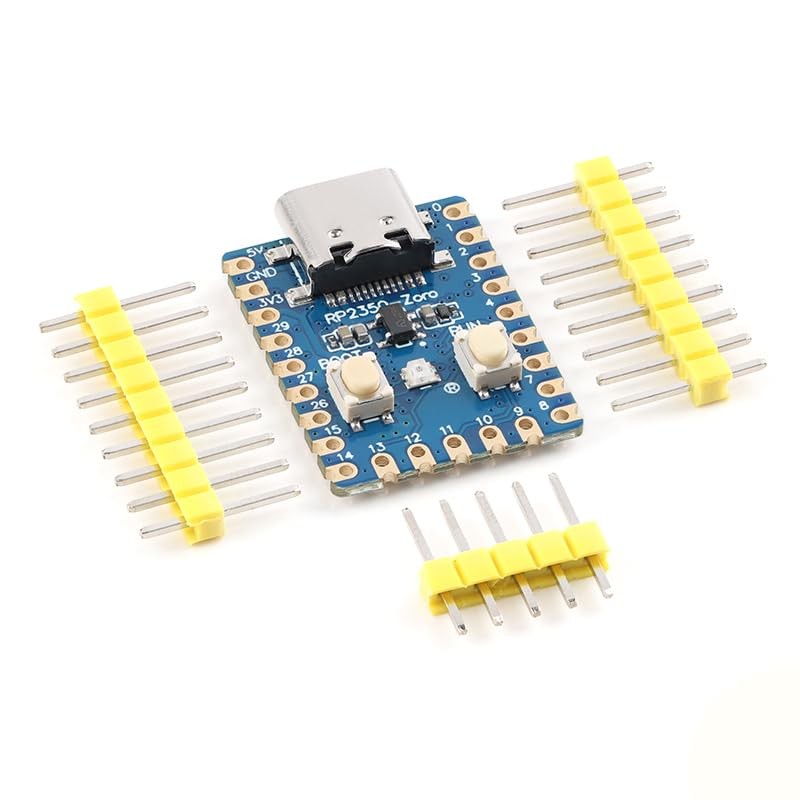
RP2350-Zero Development Board - Unsoldered, Dual-Core Dual-Architecture MCU Board, 150MHz Core Module, USB Type-C, 520KB SRAM, 4MB Flash, Compatible with Raspberry Pi Pico EcosystemProduct Specifications- Name: RP2350-Zero Development Board- Main Chip: RP2350A- Core Architecture: Dual-core, dual-architecture design- Processor Types:- Dual-core ARM Cortex-M33- Dual-core Hazard3 RISC-V- Maximum Clock Speed: Up to 150MHz- SRAM: 520KB- Flash Memory: 4MB on-chip Flash- USB Interface: Type-C- USB Support: USB 1.1 host and device modes- GPIO Pins: 29 GPIO available on RP2350A (20 exposed through header pins)- 2 ¡Á SPI- 2 ¡Á I2C- 2 ¡Á UART- Analog Functions: 4 ¡Á 12-bit ADC- PWM Channels: 16 programmable PWM channels- PIO: 12 programmable I/O state machines- Additional Features:- Built-in temperature sensor- Precise on-chip clock and timers- Accelerated floating-point library support- Low-power sleep and hibernation modesApplication Scenarios- This RP2350-Zero development board is suitable for:- Embedded system development- IoT and smart device prototyping- Robotics and motion control- Sensor data acquisition
Advanced RP2350A Microcontroller Performance: Powered by the RP2350A chip, this RP2350-Zero board uses a dual-core, dual-architecture design that combines ARM Cortex-M33 and Hazard3 RISC-V cores with speeds up to 150MHz, delivering strong performance for development, control, and custom embedded applications.
Unsoldered Design for Flexible DIY Integration: This unsoldered version is ideal for makers and engineers who want more installation freedom. The stamped-hole layout makes it suitable for direct soldering onto custom carrier boards, backplanes, or compact embedded systems where a lower-profile setup is needed.
Large Memory and Versatile Interface Support: With 520KB SRAM and 4MB Flash, the board offers ample space for code and data. It also provides 29 GPIO pins on the RP2350A, including 20 exposed through standard pin locations and additional pins available through soldering, plus 2 SPI, 2 I2C, 2 UART, 4 12-bit ADCs, and 16 PWM channels.
USB Type-C with Easy Program Loading: The onboard USB Type-C connector offers easy and reliable connection. Supports USB 1.1 host and device functions, and enables drag-and-drop programming through USB mass storage mode, helping simplify code uploading and development workflow.
Built for Advanced Applications: Includes 12 programmable I/O state machines for custom peripherals, precise onboard clock and timing features, a built-in temperature sensor, accelerated floating-point library support, and low-power sleep and hibernation modes, making it a strong choice for IoT devices, controllers, and custom electronics builds.