|
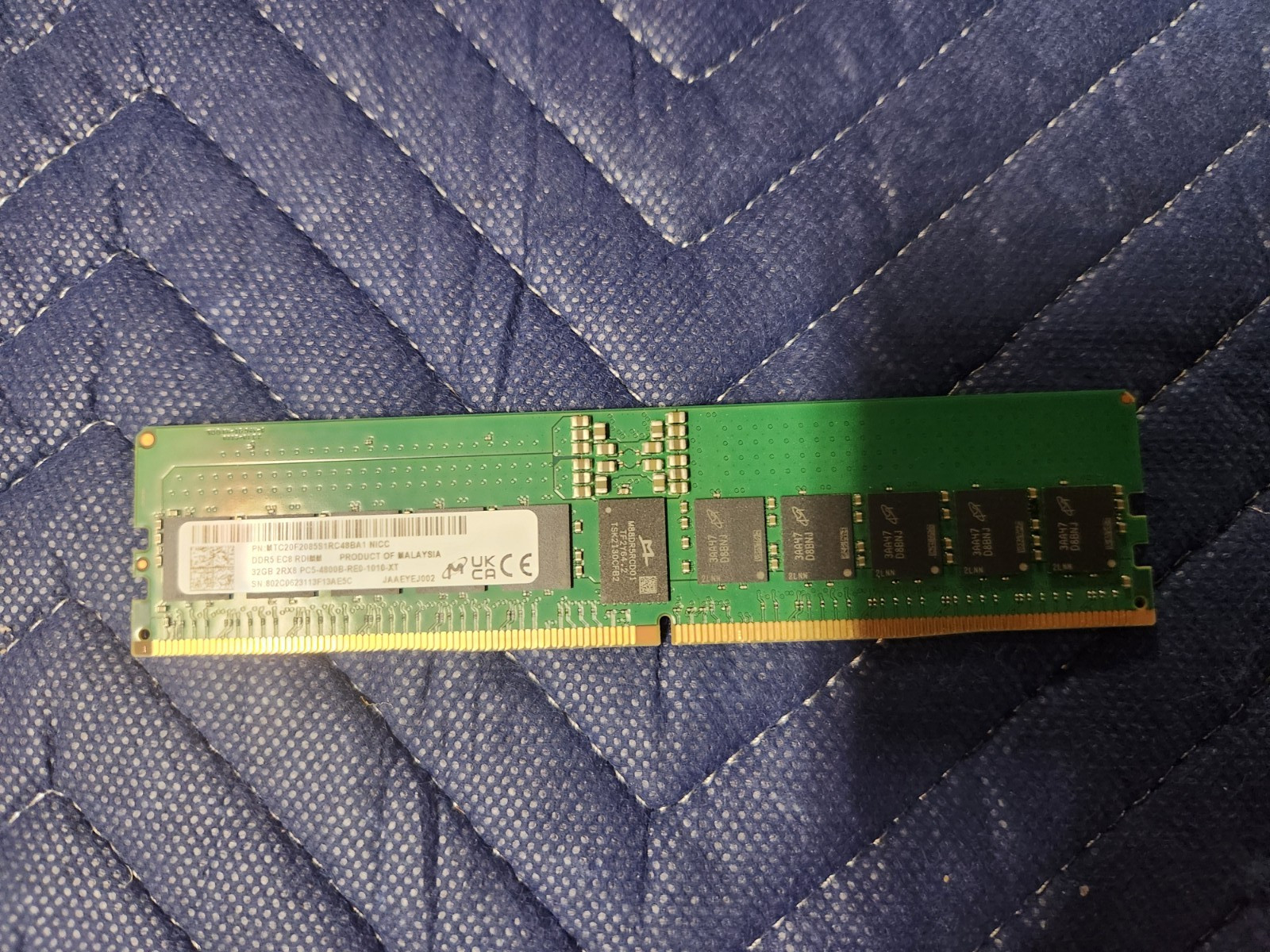
MICRON 32GB (1X32GB) 2RX8 PC5-4800B WORKSTATION/SERVER MEMORY For Sale
|
 When you click on links to various merchants on this site and make a purchase, this can result in this site earning a commission. Affiliate programs and affiliations include, but are not limited to, the eBay Partner Network. When you click on links to various merchants on this site and make a purchase, this can result in this site earning a commission. Affiliate programs and affiliations include, but are not limited to, the eBay Partner Network.
Please note: We are currently unable to ship to buyers with accounts registered in China, or those using freight forwarding addresses destined for China. Orders violating this policy will be canceled. We ship exclusively to verified physical residential and commercial addresses within the Continental United States only. We do not ship to Alaska, Hawaii, US Territories, P.O. Boxes, APO/FPO/DPO military destinations, or any intermediary services—including mail forwarders, freight forwarders, logistics centers, third-party fulfillment (3PL) hubs, drop-shippers, cargo consolidators, DDP agents, or container freight stations. Any orders violating these terms will be canceled immediately. No International Shipping. Professionally pulled from a working system, fully tested, and verified operationalTechnical Specifications MatrixThe specs below are derived from standard Micron Technology DDR5 RDIMM Architecture documentation: TechnologyPart Family / SeriesMTC20F2085S1RC48B (Varies slightly by sub-revision)Storage Capacity32 GBMemory GenerationDDR5 SDRAMForm Factor288-Pin RDIMM (Registered DIMM)Bus Speed Rating4800 MT/s / 4800 MHz (PC5-38400B / JEDEC PC5-4800B)Rank Configuration2Rx8 (Dual Rank x8 Organized Profile)Data Integrity CheckAdvanced ECC / Sub-channel EC8Signal ProcessingRegistered / Buffered with Onboard RCDSupply Voltage (VDD/VDDQ)1.1 V (Standard DDR5 JEDEC core voltage)JEDEC Timings (CL-RCD-RP)CL40-39-39Advanced Architecture & Engineering Features - DDR5 Enterprise Standard (4800 MT/s): Operates at a native bandwidth rating of 4800 MT/s, maximizing physical data transfer rates up to 38.4 GB/s per module. This delivers up to a 50% performance scaling jump over legacy DDR4 server generations, engineered to eliminate memory bandwidth bottlenecks in modern virtualized data center ecosystems. [1, 2, 3, 4]
- Dual-Rank x8 (2Rx8) Topography: Configured as a dual logical rank structure utilizing x8-width components. This architectural layout optimizes memory interleaving depth, permitting server platforms to execute overlapping data requests with minimal timing delays. [1, 2]
- On-DIMM Power Management (PMIC): Unlike legacy DDR4 architecture where power regulation was delegated globally to the host motherboard, this DDR5 layout integrates an onboard Power Management Integrated Circuit (PMIC) directly onto the module's PCB. This permits granular, highly stable voltage distribution, localized noise reduction, and an ultra-efficient nominal operating voltage of just 1.1V. [1, 2]
- Dual-Layer Sideband Reliability (EC8 & Sideband ECC): Features an advanced EC8 error correction code format. Combining traditional system-level command-and-address register shielding with DDR5's native On-Die ECC architecture, it corrects data corruption patterns locally inside the DRAM matrix before releasing signals onto the server bus. [1, 2, 3]
- Dual 32-Bit Subchannel Communication: Rather than reading memory across a single wide 64-bit bus like legacy DDR4 modules, DDR5 splits its architecture into two independent 32-bit subchannels (plus 8 ECC bits per channel) on every module. This dual-subchannel layout doubles overall access efficiency and dramatically speeds up random-access data performance.
Critical System Compatibility Requirements - Next-Gen Server Architecture Only: This component is specifically engineered for modern, DDR5-enabled enterprise server motherboards and workstations. Fully optimized for Intel Xeon Scalable 4th/5th Generation (Sapphire Rapids / Emerald Rapids) and AMD EPYC 9004 Series (Genoa / Bergamo) processor ecosystems.
- Desktop & Desktop Upgrade Incompatibility: This module will NOT work in standard consumer desktop computers, gaming rigs, or high-end consumer PCs. Standard client motherboards require unbuffered, non-registered (UDIMM) architecture and will fail to POST with an enterprise RDIMM module installed.
- DDR Generation Constraints: This is a native DDR5 module. It is physically and electrically incompatible with legacy DDR4, DDR3, or earlier memory sockets.
- Channel Class Rules: Do not combine or mix this Registered RDIMM with Unbuffered (UDIMM) or Load-Reduced (LRDIMM) server memory styles in the same memory bank or server channel. [1, 2, 3, 4]
 |
| | | | | |