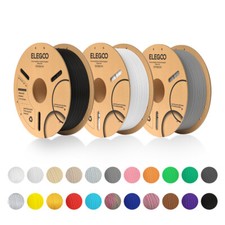
IEMAI 3D Printing Filaments IEMAI 3D Printing Materials allows you to have an excellent printing experience; with our guidance in pre/pro-processing, you will obtain a detailed and good-surface finished print prototype. Our 3D Printing Materials are independently developed and using our IEMAI 3D Printers, the filament will be able to outperform well and provide you with an amazing experience and performance for your parts or prototypes.Polylactic Acid (PLA) is a plastic extract from starch (commonly from corn) which is low environmental impact. It is a derivative of starch, green and renewable, a biodegradable material (degrade by itself in the soil), which is environmentally friendly. It is commonly used for decoration and aesthetic purposes. This material is easy to print thus it is the most suitable filament for beginners to use for their very first 3D printers.
PLA Technical Data Sheet(TDS)Polylactic Acid (PLA) is a plastic extract from starch (commonly from corn) which islow environmental impact. It is a derivative of starch, green and renewable, abiodegradable material (degrade by itself in the soil), which is environmentally friendly.
IEMAI 3D high performance PLA filament is based on FFF/FDM technology, with acommonly used diameter of 1.75 mm, 190-220ºC printing temperature,50ºC bedtemperature (May not necessary), having excellent interlayer adhesion which greatlyimprove the strength and shock resistance of the prototype.
PLA can print large models without a heating platform and warping will not happeneasily. It has a low shrinkage rate and performs well even when printing large-sizemodels. PLA is widely used in education, home, machinery, electronic appliances,instrumentation, and other fieldsPhysical Condition
- Test Method Typical ValueDensity ASTM D1505 1.24 g/𝑐𝑚3
- Mechanical Condition Test Method Typical ValueTensile Strength MD ASTM D882 110,3 MPaTD ASTM D882 144,7 MPaTensile Modulus MD ASTM D882 3309 MPaTD ASTM D882 3861 MPaElongation at Break MD ASTM D882 160%TD ASTM D882 100%Elmendorf Tear MD ASTM D1922 15g/milTD ASTM D1922 13g/mil
- IMPACT Condition Test Method Typical ValueSpence Impact 2.5 J
- Thermal Condition Test Method Typical ValueMelting Point ASTM 3418 145-160 ºC
- Transmission Rates Condition Test Method Typical ValueOxygen D1434 675 cc-mil/ m2-24hr-atmCarbon Dioxide Internal 2.850 cc-mil/ m2-24hr-atmWater Vapor ASTM F1249 375 g-mil/m2-24
- Optical 1.50 mm HB3D printing solutions for high performance materialsHaze ASTM D1003 2.10%Gloss 20ºC ASTM D1003 90
- Print RecommendationNozzle Temperature 190 -220 ºCBed Temperature 0-50 ºCPrint Speed 30-70 mm/sChamber Temperature 0-40 °CCooling Fan 0-100




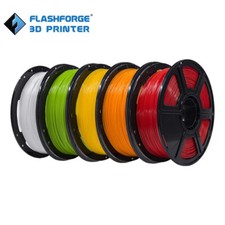
![[Buy 6 Get 4 Free] SUNLU Matte PLA/ PETG Filament 1kg 1.75mm 3D Printer Filament picture](/store/item/img/g/O6IAAeSwzM5qYbvd/s-l225/-Buy-6-Get-4-Free-SUNLU-Matte-PLA-PETG-Filament-1k.jpg)